
Golf Equipment Guide for Beginners: Everything You Need to Get Started
Starting golf without knowing what to buy is genuinely confusing. Walk into any golf shop or scroll through Amazon results and you’ll find a thousand opinions, most of them from people trying to sell you something. This guide cuts through it.
What follows is a breakdown of every category of golf equipment a beginner actually needs, what matters in each category, what doesn’t, and roughly what you should expect to spend. You don’t need the most expensive gear to enjoy the game. You need the right gear for where you are right now.
Use the sections below to jump to whatever you need. If you want to go deeper on any one topic, each section links out to our full guides.
QUICK-REFERENCE: BEGINNER GOLF EQUIPMENT CHECKLIST
| Equipment | Priority | Estimated Cost | Notes |
|---|---|---|---|
| Golf clubs (set) | Essential | $150–$400 | Buy a beginner set, not individual clubs |
| Golf balls | Essential | $15–$30/dozen | Low-compression, 2-piece |
| Golf bag | Essential | $50–$150 | Stand bag for most beginners |
| Golf shoes | Essential | $60–$130 | Waterproof with soft spikes |
| Golf glove | Essential | $10–$20 | One glove (lead hand) |
| Tees | Essential | $5–$10 | Mixed heights |
| Ball markers | Nice to have | $1–$5 | Coin works fine |
| Divot tool | Nice to have | $5–$15 | Required etiquette |
| Rangefinder | Optional | $100–$300 | Skip it until year two |
| GPS watch | Optional | $100–$250 | Same — learn first |
| Golf cart/push cart | Situational | $150–$400 | Course-dependent |
GOLF CLUBS
What You Actually Need
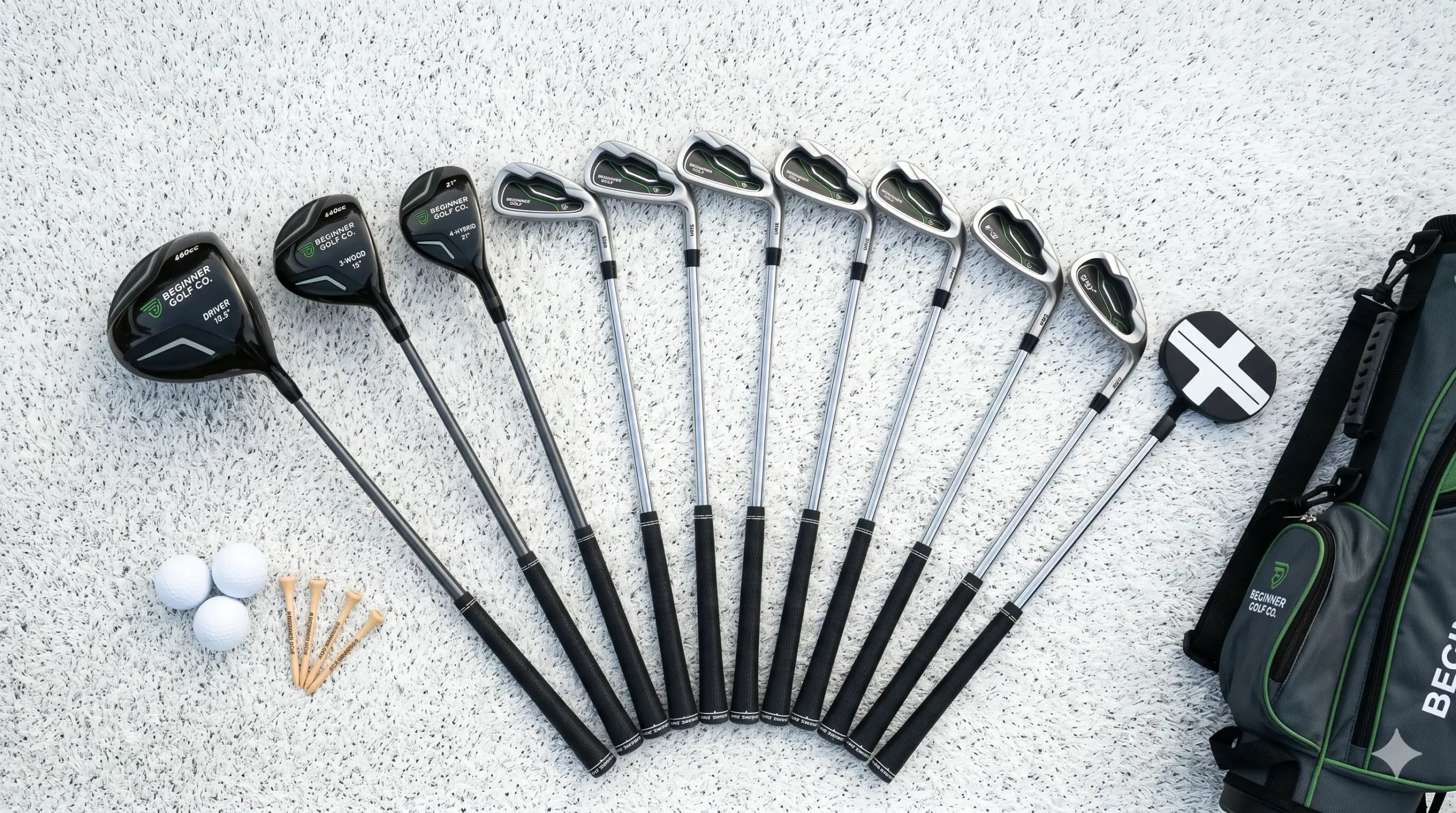
The USGA allows up to 14 clubs in your bag. As a beginner, you won’t use 14, and you don’t need 14. A solid starter set usually includes:
- Driver (1 club for tee shots)
- 3-wood or 5-wood (fairway shots and long par-3s)
- 5-iron through 9-iron (five clubs)
- Pitching wedge and sand wedge (two wedges)
- Putter
That’s 10 clubs. Plenty for a beginner. The gap wedge, lob wedge, and long irons can come later when you know what distances you’re hitting.
Complete Sets vs. Building Your Own
Buy a complete set. Building a custom set from individual clubs sounds appealing in theory, but costs more, takes more knowledge to do well, and offers no real benefit at this stage. Complete beginner sets from Callaway (the Strata series), Wilson (the Profile SGI), and Cleveland/Srixon are well-matched across clubs and sized for forgiveness.
Expect to spend $150–$400 for a decent complete set. Anything under $100 is likely to frustrate you. Anything over $500 is almost certainly more club than you need.
What to Look for in Beginner Clubs
Cavity-back irons rather than blades. Cavity-back irons have a hollow back that distributes weight around the perimeter of the clubhead, which makes off-center hits go straighter and farther than blades (which punish mishits severely). Every beginner iron set should be cavity-back. If a set doesn’t specify, look it up before buying.
A higher-lofted driver. Beginners with slower swing speeds — which is most beginners — get more distance from a 10.5- or 12-degree driver than a 9-degree. More loft means easier launch with a slower swing. A lot of starter drivers come at 10.5 degrees, which is the right place to start.
Regular or senior flex shafts. Shaft flex affects how the club bends through your swing. Stiff flex shafts are for faster swingers. As a beginner, regular flex (or senior if your swing speed is under ~80 mph) will give you a better feel and more consistent results. Most complete beginner sets ship with regular flex, but check before you buy.
Should You Buy New or Used?
Used clubs are a perfectly reasonable starting point. eBay, local Facebook Marketplace, and golf secondhand shops regularly have complete beginner sets in excellent condition for half the price of new. If you’re not sure you’ll stick with golf past six months, used is the smarter move. Once you’re committed, you can invest in a set that fits you better.
One thing to check with used clubs: shaft condition (look for cracks), grip wear (soft, tacky grips vs. hard, slick ones), and whether the set is complete. Missing the 7-iron from a used set matters.
GOLF BALLS
Why Ball Choice Matters for Beginners
Most beginners assume the ball makes almost no difference. It does, though not in the ways professionals would notice. For beginners, the main impact of ball choice shows up in:
Forgiveness. Low-spin balls reduce the effect of mis-hits. When you hit slightly off-center, a more forgiving ball stays on a straighter line. High-spin tour balls do the opposite — they amplify whatever spin you put on them, including the accidental kind that sends the ball sideways.
Distance. Low-compression balls flex more easily on impact, which helps players with slower swing speeds get more distance without more effort.
Price. You will lose golf balls. Losing a Titleist Pro V1 ($55/dozen) in the water or the woods is painful. Losing a sleeve of Srixon Soft Feel or Callaway Warbirds ($20–$25/dozen) isn’t.
What to Buy
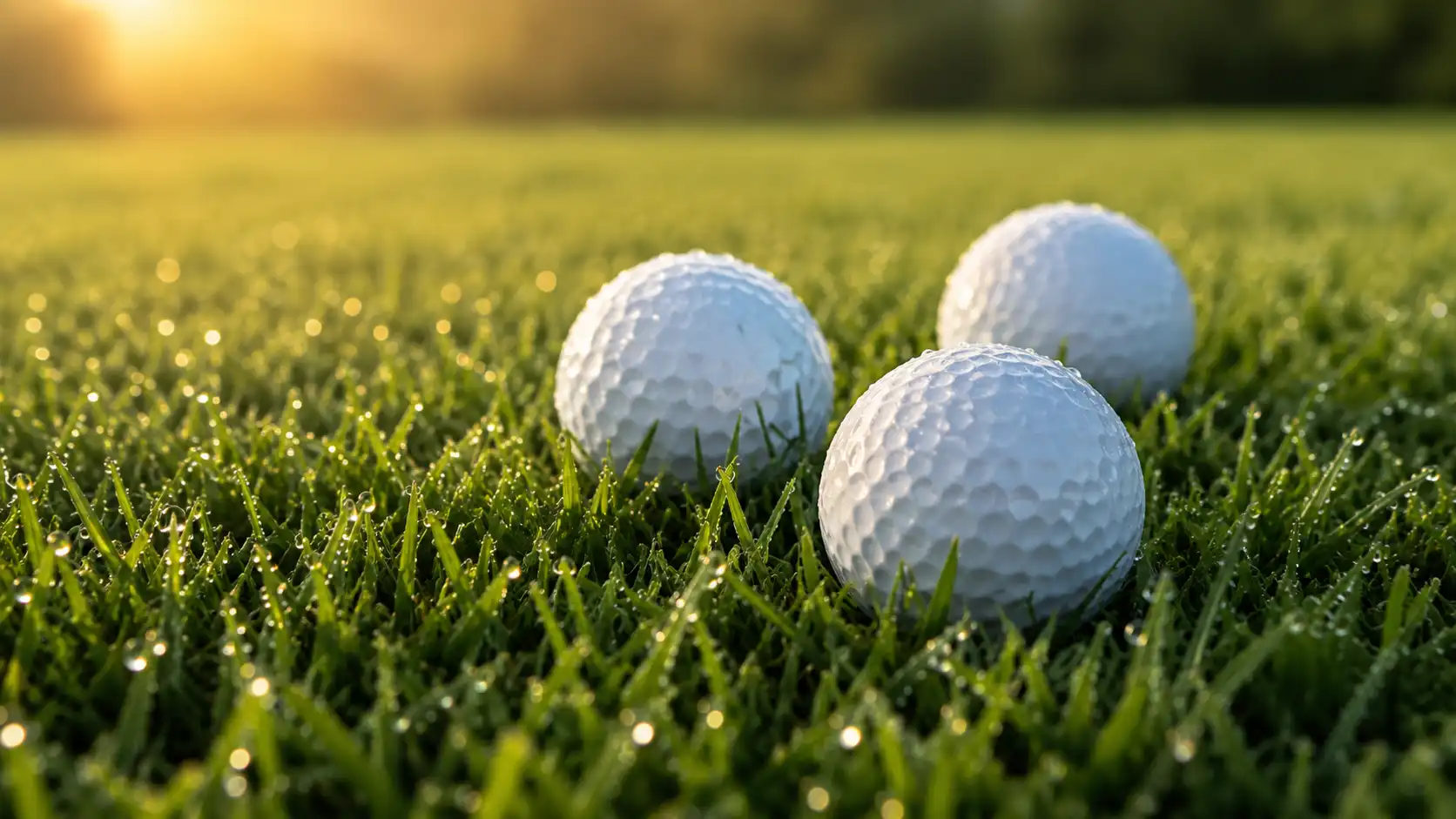
Two-piece, low-compression golf balls with a Surlyn cover. This describes most balls marketed toward beginners and high handicappers. Specific models worth starting with: the Srixon Soft Feel, Callaway Supersoft, Titleist TruFeel, and Wilson Staff Fifty Elite. All of them give you distance, some forgiveness, and durability without charging tour-ball prices.
Avoid the Pro V1, TP5, and Chrome Soft until your handicap drops below 18. Those balls are engineered for swing speeds and precision that most beginners don’t have yet. The extra spin control they offer works against you at this stage.
For a full breakdown including compression charts and more specific recommendations, read our Best Golf Balls for Beginners guide.
GOLF SHOES
Do You Really Need Golf Shoes?
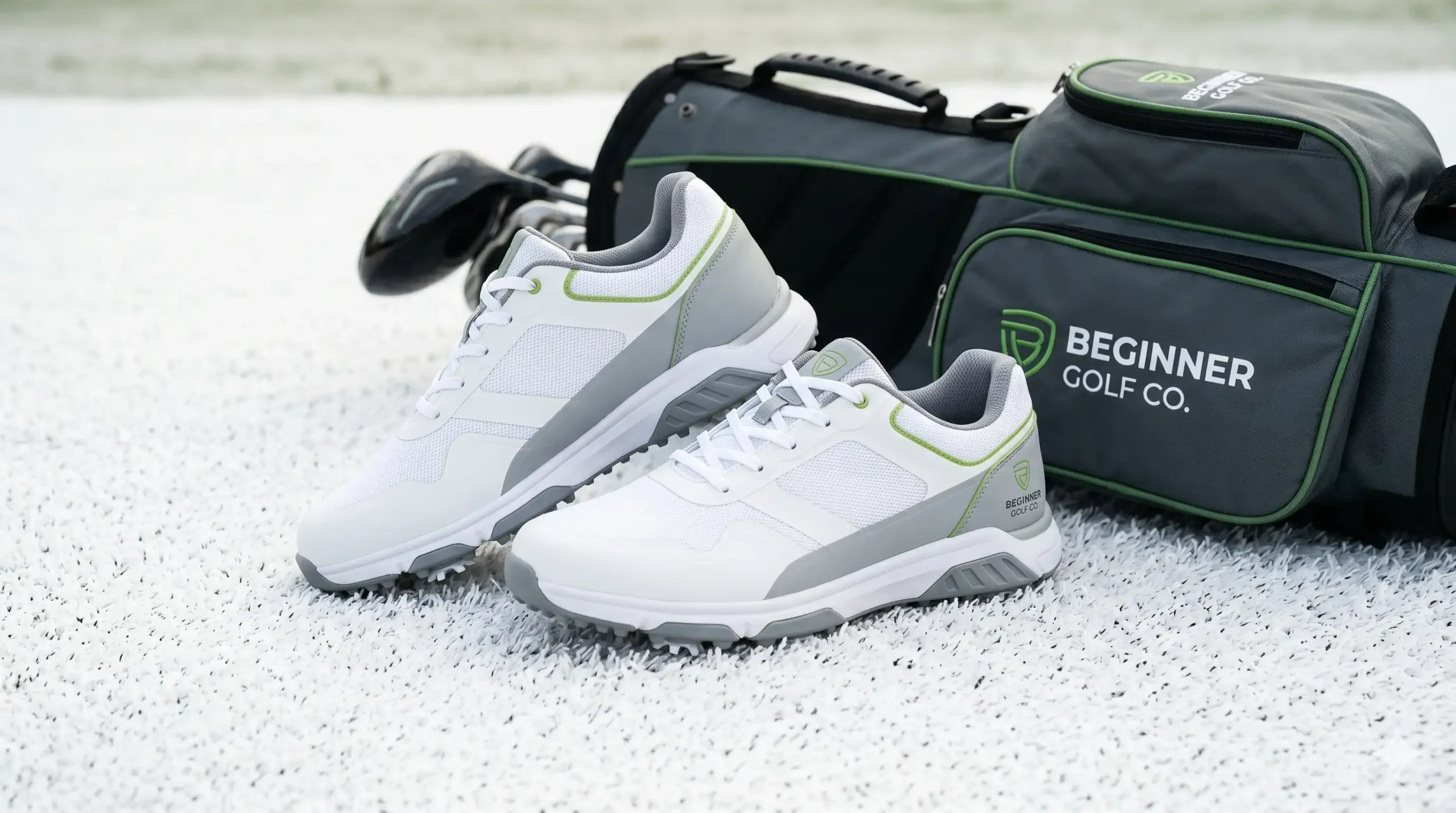
Technically, no. Practically, yes. Golf shoes solve two problems sneakers don’t: stability during your swing and traction on wet turf. Both matter more than people expect. A swing generates rotational force through your feet and into the ground. If your shoes slip or your foot rolls, your shot goes sideways. On a wet Florida morning — and on the Emerald Coast, there are plenty of those — regular sneakers turn slick fast.
Most courses also have policies about proper footwear. Spike-less golf shoes and soft-spike shoes are accepted almost everywhere. Metal spikes are banned at most modern courses.
Soft Spikes vs. Spike-less
Spike-less golf shoes look like athletic sneakers and work well on firm, dry turf. They’re comfortable enough to wear off the course. Soft-spike shoes have small rubber cleats that dig in slightly for better grip, particularly on wet or hilly terrain. The Emerald Coast gets significant moisture, so soft spikes are the safer default for local play.
Brands that consistently offer good beginner-priced options: FootJoy (the Flex and Prolite lines), Skechers GO GOLF (underrated for comfort), Adidas Codechaos, and ECCO (pricier but durable). Expect to spend $60–$130 for a solid pair. Anything under $50 tends to fall apart quickly.
Waterproofing
Look for a waterproof rating if you play early mornings or after rain. FootJoy’s waterproof guarantee is one of the better ones in the category. Not every shoe labeled “water-resistant” is actually waterproof, so read the product specs carefully.
GOLF BAG
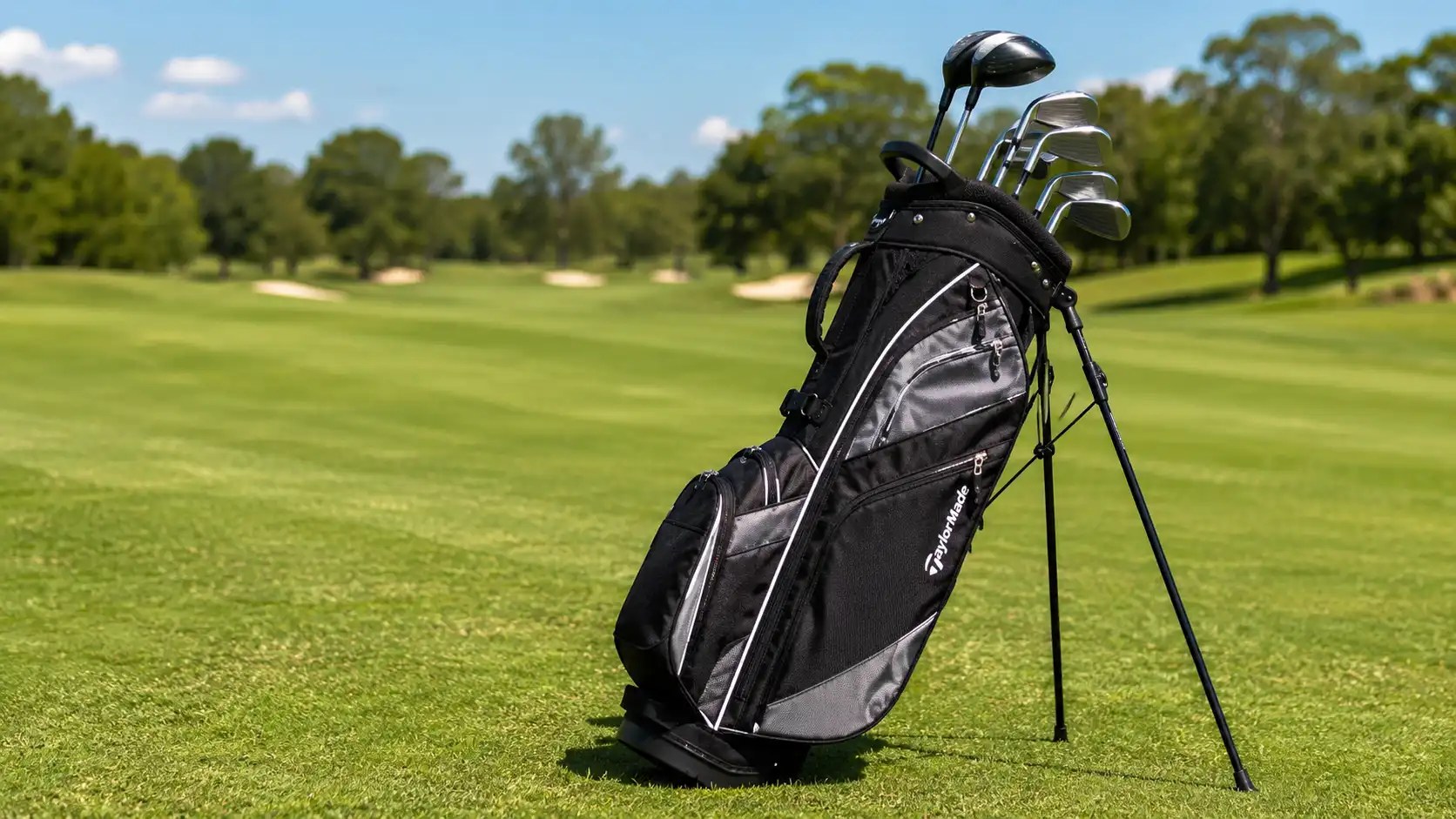
Types of Golf Bags
There are three main types you’ll encounter as a beginner:
Stand bag. Has built-in legs that pop out when you set the bag down. The default choice for most recreational players. Comfortable to carry, easy to access clubs, and works whether you’re walking or riding.
Cart bag. Designed to sit on a motorized cart or push cart. Heavier and bulkier than a stand bag, but usually has more storage and better organization. Good choice if you always ride.
Sunday bag. Lightweight and minimal. Usually holds only a handful of clubs. Good for practice rounds or par-3 courses, not a full round.
For most beginners, a stand bag is the right call. It keeps your options open — you can walk or ride, play full rounds or practice sessions.
What to Look For
Look for double shoulder straps (single-strap bags are harder on your back), at least four to five club dividers (so shafts don’t clank together), a decent number of pockets, and a rain hood. You don’t need 15 pockets. You need room for balls, tees, a glove, your phone, and maybe a snack.
Brands worth considering at the beginner price range: Callaway, Sun Mountain, Bag Boy, and Ping. Expect to spend $80–$150 for a bag that holds up through several years of play.
GOLF GLOVE
Why One Glove, Not Two
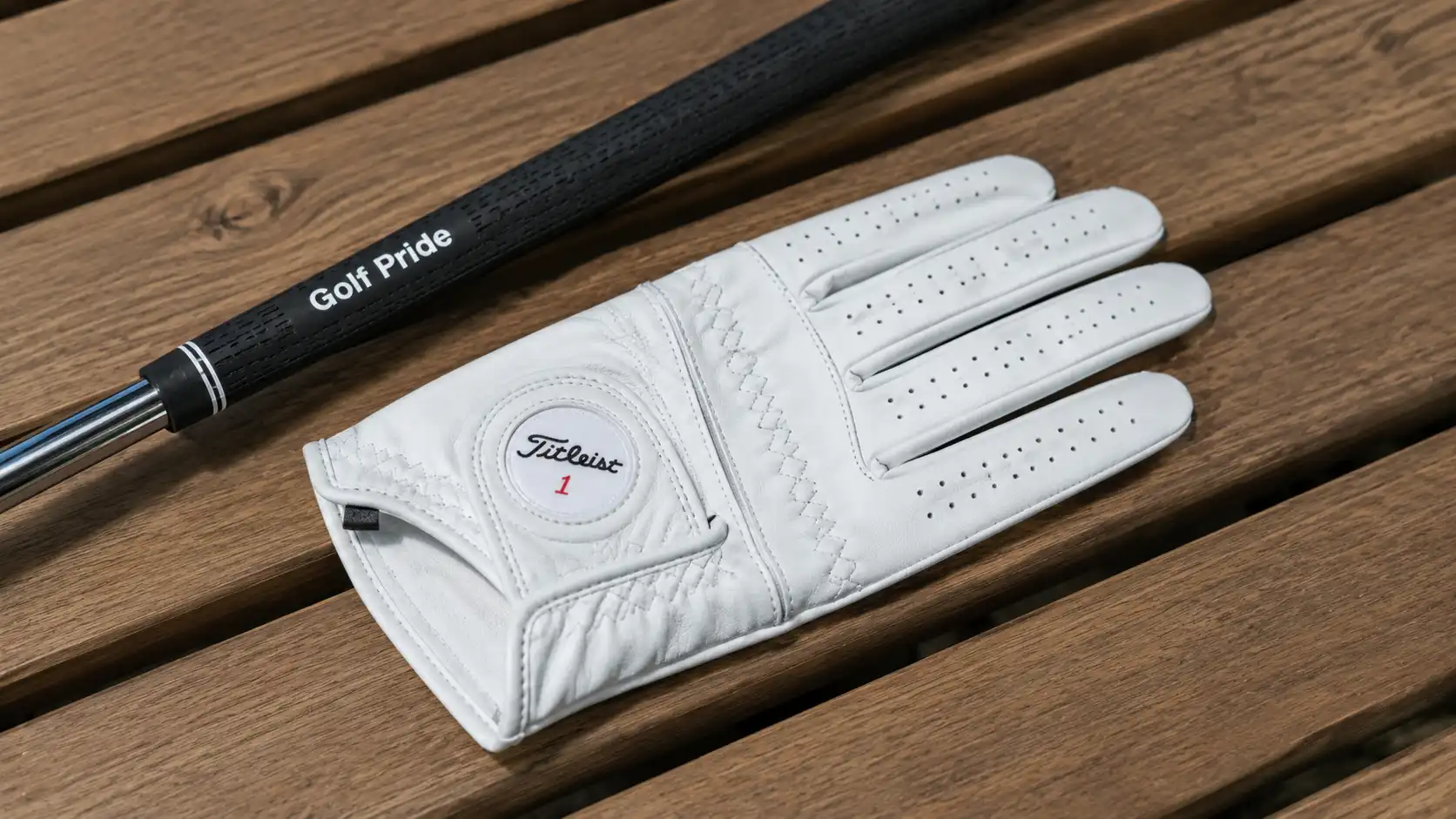
Golf is played with one glove on the lead hand — the left hand for right-handed golfers, the right hand for left-handed golfers. The glove improves grip, reduces the chance of the club slipping during the swing, and protects against blisters when you’re playing regularly. Two gloves are worn only by a small number of players, usually for warmth or skin sensitivity.
A bad grip is one of the most common beginner problems. A good glove doesn’t fix a bad grip, but it stops the club from moving in ways you don’t want during the swing.
What to Look For
Fit matters more than brand. A golf glove should feel snug across the palm and fingers without restricting movement. Too loose and it bunches up; too tight and it affects feel. Most brands size gloves S/M/L/XL with cadet sizing available for shorter fingers relative to palm width.
Leather gloves (Cabretta leather specifically) provide the best feel but wear out faster, especially in heat and humidity. Synthetic gloves are more durable and hold up better in warm, sweaty conditions. On the Emerald Coast where summer rounds are hot and humid, synthetic or hybrid gloves last longer.
FootJoy StaSof, Titleist Players, and Callaway Dawn Patrol are reliable options. Expect to spend $10–$20.
GOLF TEES
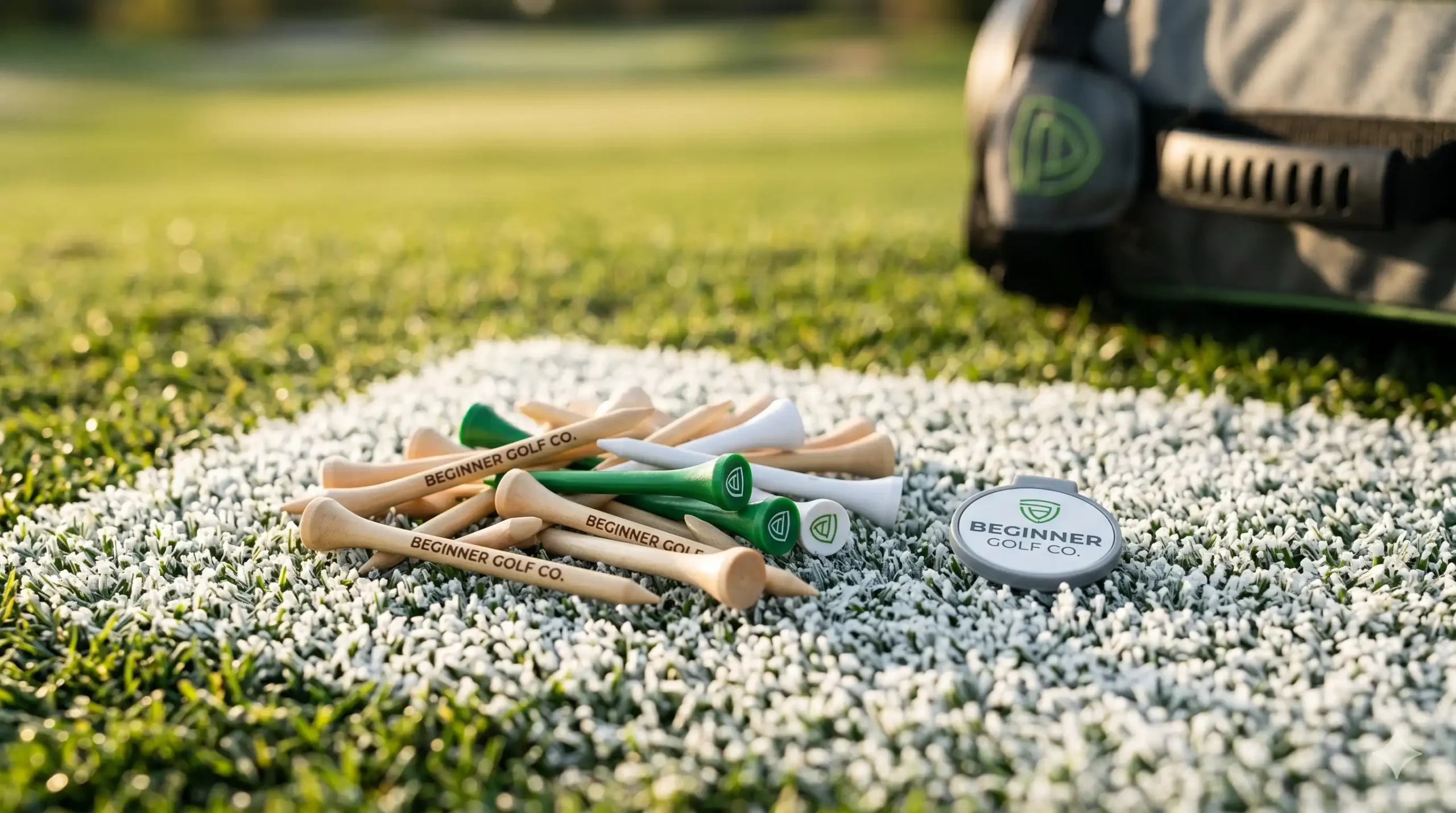
Golf tees are cheap and easy. You need a mix of heights:
3.25-inch tees for your driver. Teeing the ball higher helps you catch it on the upswing, which is how you maximize distance with a driver.
2.75-inch tees for fairway woods and hybrids.
1.5-inch or shorter tees for irons on par-3s when you want the ball just barely off the ground.
Plastic tees last longer than wood. Brush tees and zero-friction tees claim to reduce drag — and they work marginally — but for beginners, standard tees are perfectly fine. Buy a bag of mixed-length tees for $5–$10 and you’re set for months.
RANGEFINDER OR GPS
Should Beginners Invest in a Rangefinder?
The honest answer is: probably not yet.
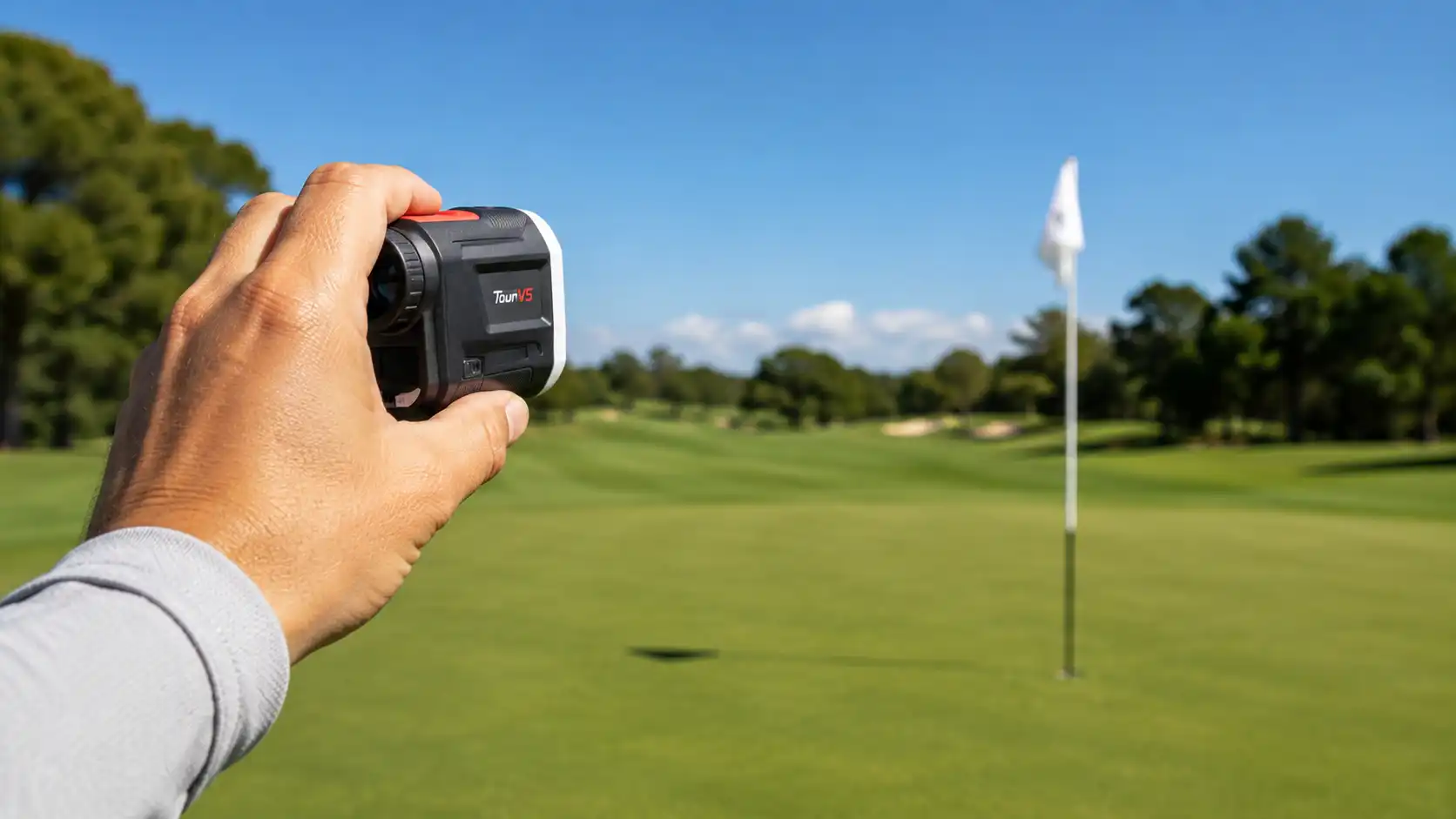
A rangefinder gives you precise yardage to the flag. That’s genuinely useful information. But it’s most useful when you know exactly how far you hit each club. Most beginners don’t know that yet, because their distances vary significantly shot to shot while they’re still building a repeatable swing.
Using a rangefinder before you know your distances is like knowing exactly how far you need to throw a baseball before you’ve learned to throw consistently. The data is accurate; the application is premature.
Once you’ve played 20–30 rounds and have a reasonable feel for your distances — maybe you know your 7-iron goes around 130 yards, your 6-iron around 145 — a rangefinder becomes genuinely useful. That’s when to invest.
Rangefinder vs. GPS Watch
Rangefinders (Bushnell Pro X3, Precision Pro NX10) give exact point-to-point distances but require you to aim them at the flag. GPS watches (Garmin Approach, Shot Scope) give automatic front/middle/back distances to every green and sometimes show hazards. Watches are more convenient; rangefinders are more precise. Most serious players end up with both eventually.
For beginners: if you must have one, a mid-range GPS watch ($100–$180) is more practical because it works automatically and costs less than a quality rangefinder.
PUSH CART OR MOTORIZED CART
Walking vs. Riding
Golf courses vary significantly in how walkable they are. Some Emerald Coast courses, like Regatta Bay, are flat and walk-friendly. Others have significant elevation changes or cart-path-only policies that make walking impractical.
If you plan to walk, a push cart (also called a trolley) keeps your bag off your back and makes the round more comfortable. Manual push carts (Bag Boy, Caddytek) run $100–$200. Electric/motorized push carts run $300–$500 and up.
If you plan to ride in a motorized cart, you don’t need a push cart. Most courses include cart rental in the greens fee or offer it for an additional charge.
Beginners who walk often find the pace of play actually helps them — more time between shots to think and reset. If your home course allows and encourages walking, a push cart is worth the investment.
ACCESSORIES YOU DON’T NEED (YET)
A few things that are marketed to beginners but can wait:
Launch monitor. Excellent data, useful for understanding your swing. Irrelevant until you have a repeatable swing to analyze.
Alignment sticks. Good practice aids. Worth adding eventually. Not day-one gear.
Specialty wedges. You get a pitching wedge and sand wedge in most starter sets. That’s enough for now.
Golf towel. Actually useful. Keep one on your bag to clean club faces and balls. This is worth the $10.
Umbrella. If you’re playing in Florida, yes. Get one that clips to your bag.
PUTTING IT ALL TOGETHER: WHAT TO SPEND
A realistic beginner budget breaks down like this:
| Item | Budget Option | Mid-Range Option |
|---|---|---|
| Club set | $150–$200 (Wilson Profile, used Callaway Strata) | $250–$400 (Callaway Strata, Cleveland HB Turbo) |
| Bag | $60–$90 | $100–$150 |
| Shoes | $60–$80 | $90–$130 |
| Balls (2 dozen) | $25–$40 | $40–$60 |
| Glove | $10 | $15–$20 |
| Tees + accessories | $10–$15 | $10–$15 |
| Total | $315–$425 | $505–$775 |
You can get started for under $450. You do not need to spend $1,000+ on beginner gear. Save that for when you know the game well enough to know what you want.
RELATED GUIDES
- Best Golf Balls for Beginners
- How Far Should You Hit Each Club?
- Best Destin Florida Golf Courses
- Emerald Coast Golf Vacation Guide
FREQUENTLY ASKED QUESTIONS
What is the most important piece of golf equipment for beginners? Clubs, specifically a complete beginner set. Everything else is secondary. Bad clubs make the game harder than it needs to be; good beginner clubs make off-center hits more forgiving.
How many clubs does a beginner need? Ten is plenty. The USGA maximum is 14, but a driver, one fairway wood, five or six irons, two wedges, and a putter will cover every situation you’ll encounter as a new player.
Should beginners buy expensive golf balls? No. Beginners lose more balls per round than experienced players, and expensive balls offer performance benefits that only show up when swing speed and consistency are higher than most beginners have. A good $25/dozen ball will serve you better at this stage.
Are golf shoes required? Most courses require proper golf footwear, which means golf shoes or golf sandals. Regular sneakers are often allowed at driving ranges and pitch-and-putt courses but may not be accepted at full-length courses. Soft-spike or spike-less golf shoes are accepted everywhere.
What’s the difference between a stand bag and a cart bag? A stand bag has retractable legs so it stands upright when set down and is designed to be carried. A cart bag is heavier, has more storage, and is designed to sit on a motorized or push cart. Beginners who want flexibility should start with a stand bag.
When should I invest in a rangefinder? After you’ve played 20–30 rounds and have a reasonable sense of your yardages with each club. Before that, the data is accurate but you don’t have enough reference points to use it effectively.
Can I start with used clubs? Yes, and it often makes sense. Look for complete sets in good condition on eBay, Facebook Marketplace, or at a local golf shop that sells used gear. Check for shaft damage, grip condition, and completeness before buying.
Best Golf Balls For Beginners
Best Golf Balls For Beginners The best golf balls for beginners aren't the ones tour pros use. They're the ones that give you more room for error, fly farther on a slower swing, and don't punish you every time you catch the ball a little thin. That's a different set...
How Far Should You Hit Each Club?
How Far Should You Hit Each Club? Average Golf Club Distances Explained Understanding how far you should hit each club is one of the most practical — and most overlooked — skills in golf. Whether you are a weekend warrior trying to stop overshooting greens or a...