How Far Should You Hit Each Club? Average Golf Club Distances Explained
Understanding how far you should hit each club is one of the most practical — and most overlooked — skills in golf. Whether you are a weekend warrior trying to stop overshooting greens or a serious player building a complete yardage book, knowing your actual carry distances transforms course management and shot selection.
This guide breaks down the average golf club distances for every club in the bag, from the driver down to the lob wedge, organized by skill level. We will also cover the factors that influence your personal distances, how to measure them accurately, and how to use this information to start shooting lower scores.
Table of Contents
- Why Club Distance Matters in Golf
- Average Golf Club Distance Chart
- Club-by-Club Distance Breakdown
- Factors That Affect How Far You Hit the Ball
- How to Measure Your Own Club Distances
- What to Do When You Have Yardage Gaps
- Tips to Add Distance to Your Game
- Frequently Asked Questions
- About The Golfing Insider
- Recommended Resources
Why Club Distance Matters in Golf
Most amateur golfers choose clubs based on instinct or habit rather than data. They grab a 7-iron from 150 yards because that is what their playing partners do, not because they have measured their own carry distance. The result is a steady stream of shots that come up short, fly over greens, or miss by margins that feel mysterious.
Professional golfers know their carry distances to the yard. They have gap-tested every club and know exactly how far each flies under normal conditions. You do not need to be a tour player to benefit from this approach. Even a rough working knowledge of your personal yardages — within five yards — gives you a real strategic advantage on every course you play.
Beyond distance, club selection affects trajectory, spin, and how the ball reacts when it lands. A well-struck 8-iron holds a green differently than a punched 6-iron covering the same distance. Knowing your distances lets you select the right club for the right shot, not just the right yardage.
Average Golf Club Distance Chart
The table below shows average carry distances by club across three skill level categories. These figures represent typical carry distances on a normal day in moderate conditions, measured with a well-struck ball. Real-world distances will vary based on swing speed, equipment, altitude, and weather.
Note: All distances are approximate carry yardages, not total roll-out distances. Add 5–15 yards of roll depending on firmness of the turf.
| Club | Beginner / High Handicap | Mid Handicap | Low Handicap / Scratch |
|---|---|---|---|
| Driver | 200–230 yds | 230–260 yds | 260–300+ yds |
| 3-Wood | 180–210 yds | 210–235 yds | 235–270 yds |
| 5-Wood | 170–195 yds | 195–220 yds | 220–250 yds |
| 2-Hybrid | 175–200 yds | 200–225 yds | 225–255 yds |
| 3-Hybrid | 165–190 yds | 185–210 yds | 210–240 yds |
| 4-Iron | 150–170 yds | 165–185 yds | 185–210 yds |
| 5-Iron | 140–160 yds | 155–175 yds | 175–200 yds |
| 6-Iron | 130–150 yds | 145–165 yds | 165–185 yds |
| 7-Iron | 120–140 yds | 135–155 yds | 155–175 yds |
| 8-Iron | 110–130 yds | 120–140 yds | 140–160 yds |
| 9-Iron | 95–115 yds | 110–130 yds | 130–150 yds |
| Pitching Wedge | 80–105 yds | 100–120 yds | 120–140 yds |
| Gap Wedge | 70–90 yds | 85–105 yds | 105–125 yds |
| Sand Wedge | 60–80 yds | 75–95 yds | 90–110 yds |
| Lob Wedge | 45–65 yds | 60–80 yds | 75–95 yds |
Club-by-Club Distance Breakdown
Driver
The driver is the longest club in the bag and the one most golfers obsess over. Average driver distance across all amateur golfers falls somewhere between 215 and 250 yards, but USGA and Shot Scope data consistently show that most recreational players carry it shorter than they think.
High-handicap players (18+) typically carry the driver between 200 and 230 yards. Mid-handicappers average 230–260 yards. Low handicappers and scratch players regularly hit 260–300+ yards. PGA Tour pros average over 300 yards and elite long-drive competitors regularly exceed 360 yards — numbers that are not meaningful benchmarks for recreational play.
The most important driver metric is not raw distance but consistency. A player who reliably carries it 235 yards in the fairway has a significant advantage over one who occasionally rips it 260 yards but often comes up short or misses offline.
Fairway Woods
The 3-wood typically carries 15–30 yards shorter than the driver for most players. It is the go-to off the tee on tight holes and the primary option for long par-5 second shots. A mid-handicapper hitting a driver around 245 yards should expect their 3-wood to carry roughly 210–225 yards.
The 5-wood sits another 10–20 yards behind the 3-wood and is often one of the most underused clubs in the bag. Many players find the 5-wood more consistent and easier to get airborne than long irons. It is particularly useful from fairway lies when the ball needs to travel 200–215 yards.
Hybrids
Hybrids have largely replaced long irons in most recreational bags, and for good reason. They are far more forgiving and easier to launch from a variety of lies. A 3-hybrid typically covers 175–210 yards depending on skill level, while a 4-hybrid fills the gap between the 3-hybrid and the 5-iron.
Players who struggle with 4-irons and 5-irons are almost always better served by hybrids in those slots. The carry distances are similar, but the consistency and ball flight are significantly improved.
Irons (4-Iron Through 9-Iron)
Irons form the backbone of distance management on approach shots. Each iron typically yields 10–15 yards of distance difference from one club to the next, though exact gaps vary by player.
The 7-iron has historically been the benchmark club for course distance ratings and the club most often cited in average distance conversations. Average golfers carry a 7-iron between 120 and 155 yards. Many beginners overestimate this number significantly.
The 6-iron adds 10–15 yards over the 7-iron for most players. The 5-iron adds another 10–15 beyond that. At the short end, the 9-iron typically flies 95–130 yards and is one of the most important scoring clubs in the bag.
Knowing your iron distances with precision — not a range, but a specific carry number — is what separates strategic ball strikers from instinctive ones.
Wedges
Wedges serve as precision instruments. Most players carry three or four wedges: a pitching wedge (PW), gap or approach wedge (GW/AW), sand wedge (SW), and lob wedge (LW). Each serves a specific distance and shot-type role.
The pitching wedge is the longest wedge and typically carries 80–120 yards depending on skill level. The gap wedge fills the yardage hole between the PW and SW, usually covering 70–105 yards. The sand wedge sits around 60–95 yards, and the lob wedge is used for short, high shots from 45–80 yards.
Most amateur golfers have gaps in their wedge distances — ranges of 15–20 yards where no club lands consistently. Identifying and closing these gaps is one of the fastest ways to lower your scores.
Factors That Affect How Far You Hit the Ball
No two golfers hit the ball the same distance, even with identical equipment. The following variables have the greatest influence on how far the ball travels.
Swing Speed
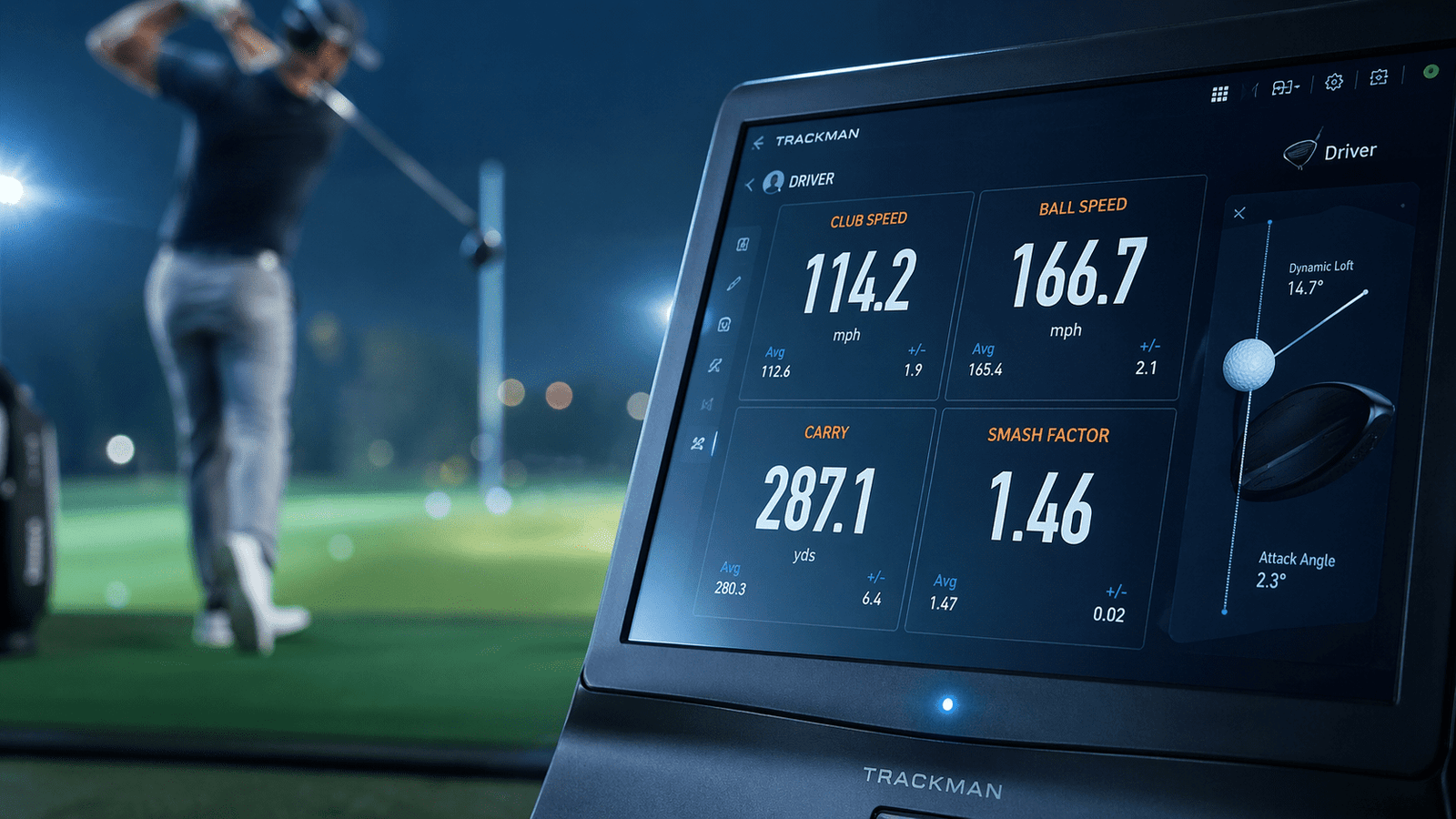
Swing speed is the single biggest driver of distance. Ball speed is roughly 1.4–1.5 times your clubhead speed at impact with a driver. A player swinging at 85 mph will hit it substantially shorter than one swinging at 105 mph. Increasing swing speed — through flexibility training, strength work, or swing efficiency improvements — is the most reliable path to more distance.
Strike Quality and Smash Factor
Smash factor measures the efficiency of impact: ball speed divided by clubhead speed. The theoretical maximum smash factor with a driver is 1.50, meaning no energy is lost at impact. An off-center strike can reduce smash factor dramatically, costing distance even with a fast swing.
Equipment and Shaft Flex
Properly fitted equipment makes a measurable difference. A driver with the wrong shaft flex, wrong loft, or suboptimal clubhead will not perform as well as one matched to your swing characteristics. Iron lofts have also gotten stronger over the years — modern 7-irons often have the same loft as the 5-irons of two decades ago — so club labels do not always correspond to traditional distances.
Ball Type
Golf ball construction significantly affects distance. A two-piece ball designed for distance and low spin will travel farther than a four-piece tour ball optimized for spin control. Higher-handicap players who need more distance often benefit from a distance ball, while lower handicappers may prefer a tour ball for short game control.
Weather and Altitude
Cold air is denser and slows the ball. A player who carries their 7-iron 150 yards on a warm summer day might see it drop to 140–143 yards in cold winter conditions. Altitude has the opposite effect: at 5,000 feet elevation, the same player might carry 158–165 yards because the thin air provides less resistance. Wind, humidity, and temperature all affect ball flight.
Launch Angle and Spin Rate
The optimal launch angle and spin rate for maximum distance is generally around 10–14 degrees of launch with 2,400–2,800 rpm of backspin for a driver. Most amateurs either launch too low with too much spin (creating a balloon ball flight) or too low with too little spin (resulting in a boring trajectory that runs out of steam). A launch monitor fitting session can identify and correct these issues.
How to Measure Your Own Club Distances
Average distance charts give you a useful starting point, but your personal yardages are what matter on the course. Here are the most effective methods:
- Use a launch monitor session. Services like TrackMan, Foresight, or FlightScope sessions at a local fitting center or golf simulator give you precise carry distances for every club under controlled conditions. This is the most accurate method available.
- Use a GPS rangefinder or laser during practice rounds. Hit shots on the course and pace off the distance to where they land. Do this multiple times per club and average the results.
- Use a simulator or indoor facility. Many golf facilities offer simulator bays with launch monitors included — convenient, weather-independent, and consistent.
- Track your rounds with an app. Shot Scope, Arccos, and Garmin Golf use automatic shot tracking to build a statistically meaningful picture of your actual distances over time, averaging out the outliers to give you real-world carry data.
The key is to measure your average carry distance — not your best shot, not your worst shot, but the number you hit the majority of the time with a well-struck ball. Most golfers overestimate this number by 10–20 yards.
What to Do When You Have Yardage Gaps
After measuring your distances, compare them to see how evenly spaced your clubs are. Ideally, you want consistent 10–15 yard gaps between clubs throughout the bag. Gaps that are significantly wider than this — say, 25+ yards between two clubs — leave you without a confident club for approach shots in that range.
Common ways to close yardage gaps include:
- Adding a gap wedge if the distance between your PW and SW exceeds 20 yards
- Replacing a 4-iron with a 4-hybrid if the 4-iron is difficult to hit consistently
- Getting a custom fitting to adjust lofts on your irons to create even spacing
- Adding a fairway wood or utility iron to fill the gap between your driver and longest iron
Adjusting your swing — hitting a specific club at 80% effort or choking down on the grip — is also a reliable way to cover awkward in-between yardages without adding new clubs.
Tips to Add Distance to Your Game
If your current distances are shorter than you would like, there are proven ways to add yards without overcomplicating your swing:
- Work on flexibility and rotation. More hip and shoulder turn generates more potential swing arc. Yoga, stretching routines, and rotational exercises all contribute to a wider, faster swing.
- Improve your impact position. Hitting the ball with a square, centered impact is more important than swinging harder. A 10% increase in smash factor adds more distance than a 10% increase in swing speed with a poor strike.
- Get a proper shaft fitting. The right shaft flex, weight, and kick point for your swing speed and tempo makes a measurable distance and accuracy difference.
- Switch to a distance ball. If you are playing a tour ball but your short game does not require it, switching to a two-piece distance ball can add 5–15 yards off the tee.
- Play the right tee boxes. Aligning your tee selection with your actual driving distance makes the course play as designed and keeps the game enjoyable and strategic.
Frequently Asked Questions
How far should a beginner hit a 7-iron?
Most beginners and high-handicap players carry a 7-iron between 100 and 130 yards. Do not worry about matching tour distances. Focus on consistent contact and your numbers will improve naturally over time.
What is the average driver distance for an amateur golfer?
According to Shot Scope data from millions of tracked rounds, the average amateur golfer carries the driver approximately 215–225 yards. Most players believe they hit it farther than they actually do, so tracking your shots with GPS technology gives you a more accurate picture than memory alone.
How far does the average golfer hit a pitching wedge?
The average amateur golfer hits a pitching wedge between 90 and 115 yards. Elite players regularly carry it 120–135 yards. If your PW goes 80 yards and your 9-iron goes 130, that 50-yard jump signals a loft or fitting issue worth investigating.
Should I always use the same club from the same yardage?
Not necessarily. Course conditions, elevation changes, wind, and lie all affect which club is best for a given distance. Use your base yardage as the starting point, then factor in conditions. A 150-yard shot into a stiff headwind might call for a 6-iron even if your 7-iron covers 150 yards in calm conditions.
How do I know if I have yardage gaps in my bag?
Measure the carry distance for every club using a launch monitor or GPS tracking app. List them in order from longest to shortest and look for jumps greater than 20 yards between consecutive clubs. Those are your gaps — and they represent scoring opportunities you are leaving on the table every round.
At what age does golf distance start to decline?
Most golfers begin to see distance decline in their mid-50s to early 60s as swing speed naturally decreases with age. However, regular strength and flexibility training can significantly slow this decline. Some players maintain strong distances well into their 60s and 70s.
Is it better to have one fewer club and be between distances, or carry a full set?
A full set of 14 clubs is almost always preferable. The question is which 14 clubs make sense for your game. Every player should have a club they trust for each major distance range. If you find yourself repeatedly between clubs, that is a sign to re-examine your bag composition, not to play with fewer options.
About The Golfing Insider
TheGolfingInsider.com is for anyone who loves the game of golf. Whether you’re new or experienced, we share simple, practical insights to help you enjoy the game and play a little better each round.
We also cover golfing news, including updates on local courses, events, and happenings that matter to players. Our content is based on real-world experience, publicly available data, and a genuine curiosity about the game—from equipment to strategy and everything in between.
At its core, this site is just about enjoying golf and staying connected to it.
Recommended Resources
Internal Links (add these to your site):
- Best Golf Clubs for Beginners — link to your beginner club guide
- How to Build a Yardage Book for Any Course — link to your course management article
- Golf Club Fitting Guide: What to Expect and What to Ask — link to your fitting article
- Best Golf GPS Watches and Rangefinders — link to your gear review article
External References:
- USGA Equipment Standards — conforming club and ball specifications
- Shot Scope Distance Insights — real-world amateur distance data from millions of tracked rounds
- PGA Tour Stats — tour driving distance and accuracy statistics
- MyGolfSpy Independent Testing — unbiased equipment reviews and performance data